

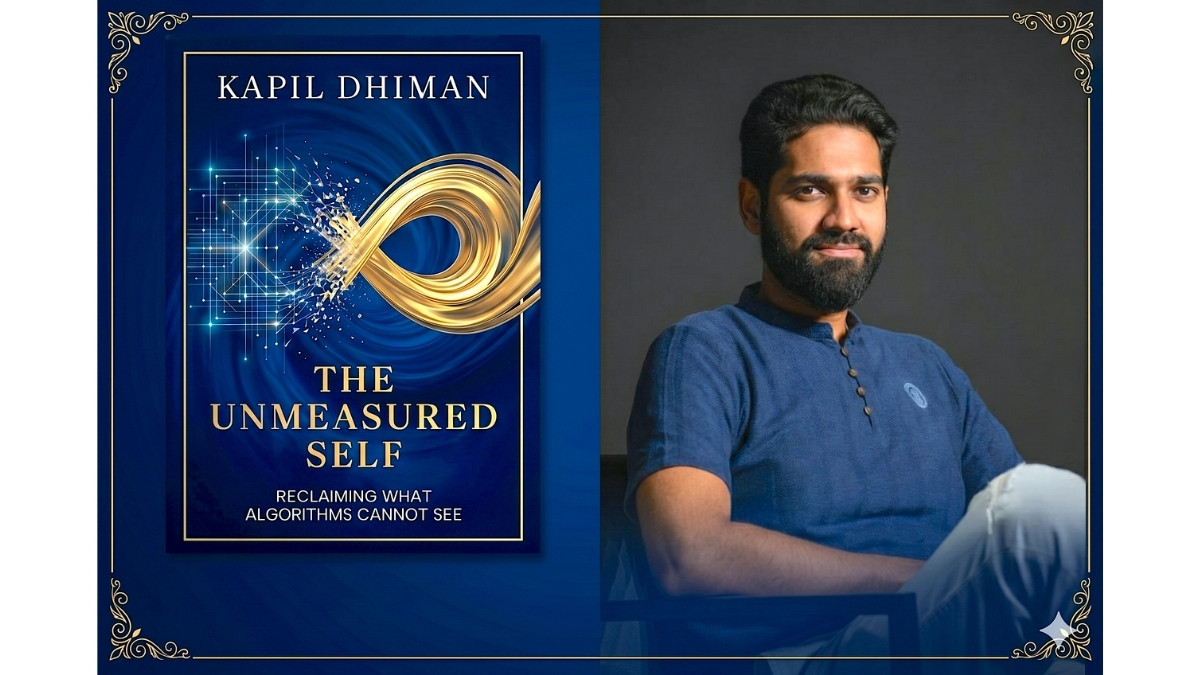
New Delhi [India], June 01: The growing global appetite for big-idea non-fiction that connects science, philosophy, and the human condition continues to reshape contemporary writing, and entrepreneur-author Kapil Dhiman is contributing to that evolving genre with the release of The Unmeasured Self: Reclaiming What Algorithms Cannot See, his second full-length work.
This book serves as a philosophical lens to examine selfhood, society, and meaning in an age increasingly shaped by algorithms. Positioned at the intersection of science writing, behavioural philosophy, and contemplative non-fiction, The Unmeasured Self opens with a deceptively simple question.
The familiar adage that “you are the average of the five people you spend the most time with” was true for most of human history. But for the average human in the 21st century, those five companions are no longer people at all – they are technologies.
The book begins from that observation and builds outward across four parts, moving from the binary world the industrial age trained us to live inside, to a quantum reframing of identity, to civilizations as collective qubits, to what the author calls a spiritual synthesis.
At the centre of the book is a deliberate metaphor.
Classical computers reduce reality to bits – definite zeroes and ones, certain, deterministic, measurable. Quantum computers work in qubits, which exist in superposition, holding contradictory possibilities at once until measurement collapses them into a single outcome.
The Unmeasured Self argues that human beings, too, have been compressed into bit-like categories – successful or failed, productive or lazy, healthy or unhealthy – by the metrics of school systems, workplaces, social platforms, and algorithmic feeds. The book invites the reader to consider the possibility that we have always been qubits being measured as bits, and that the cost of that compression is the part of the self the world’s instruments were never built to see.
Across forty-six chapters, the book moves through a deliberately wide arc.
Part I examines how algorithms now occupy the social and emotional space once held by family, neighbours, and community – drawing on cases from WhatsApp in India, WeChat in China, mobile-money networks across Africa, and algorithmic companionship in Japan.
Part II turns to quantum mechanics – Schrödinger’s cat, the Bloch sphere, Google’s Sycamore experiment – and asks what these ideas mean for how we hold contradiction, uncertainty, and identity.
Part III scales the metaphor up, treating civilizations as living qubits, from Athens and Baghdad to Florence, and reading generations as waves of probability through the Greatest Generation, the Boomers, the Millennials, Gen Z, and Generation Alpha.
Part IV synthesises physics, psychology, and mysticism into a final framework the book calls “living as a quantum soul.”
Rather than presenting itself as either a science book or a self-help book, The Unmeasured Self sits in a deliberately hybrid register. It draws on Jonathan Haidt, Cal Newport, Tristan Harris, Iain McGilchrist, Robin Dunbar, Nicholas Christakis, and James Hillman, but does not aim to summarise their work. Its argument is that contemporary culture has run out of room inside binary categories, and that a quantum vocabulary – superposition, entanglement, error correction, the observer effect – gives the modern reader a more honest set of tools for the parts of life that refuse to behave like data.
Commenting on the book, Dhiman has stated that the work began as a private inquiry rather than a public project.
“This is the first thing I have built that cannot be measured in revenue, valuation, or headlines,” he has written of the book. “It is the work I have been doing on myself, all along – quietly, alone, before anyone was watching.”
The book’s epilogue, titled The Silence Between Notes, closes with the line, “The book ends here. But your experiment begins now.”
Dhiman is the Founder and CEO of Quranium, the quantum-secure Layer-1 infrastructure for institutional finance, and a Chartered Accountant who cleared the examination in his first attempt. Before founding Quranium he led the Web 3.0 business at PwC and built MetaStudios, named Metaverse Startup of the Year in 2023.
The son of an Indian Air Force officer, he grew up across the country, competed as a sportsman at the national level, was the Best Cadet of his National Cadet Corps battalion, and worked as a music producer with over ninety songs sold before turning fully to technology. He has read, by his own account, more than a thousand books, and undertook a self-directed multi-year study of psychology, sociology, and the Civil Services syllabus to deepen his understanding of human and institutional behaviour.
Dhiman’s excellence has been covered by global tier-one international media including WIRED, CNBC, Entrepreneur, Cointelegraph, Nokia’s research division, CEOWORLD as a thought leader and celebrated as an awarded Entrepreneur. He has spoken at more than 300 international engagements across the globe, including a TEDx address on the post-quantum transition, and hosts the Quantum Minds podcast, heard in 35 countries. He is a founding member of the DavosWeb3 Roundtable and a signatory of the Davos Declaration. In 2026, he was honoured with the Rashtra Seva Award in India for his contribution to technology and digital resilience.
The release of The Unmeasured Self also reflects the broader rise of Indian-author non-fiction that engages with global ideas on their own terms. Over the past decade, readers – particularly in the post-pandemic, post-AI moment — have shown a growing appetite for books that bridge science and meaning, technology and interiority, rather than treat them as separate genres.
In that context, The Unmeasured Self enters a conversation that includes Jonathan Haidt’s recent work on the rewiring of childhood, Cal Newport’s writing on attention, and Iain McGilchrist’s two-volume case for the right hemisphere of the brain – while making a distinctly Indian contribution to it.
With the release of his second book, anticipation is expected to grow around Dhiman’s continuing body of work at the intersection of technology and the human condition. The author has indicated that further writing in the same lane will follow.
If you object to the content of this press release, please notify us at pr.error.rectification@gmail.com. We will respond and rectify the situation within 24 hours.