

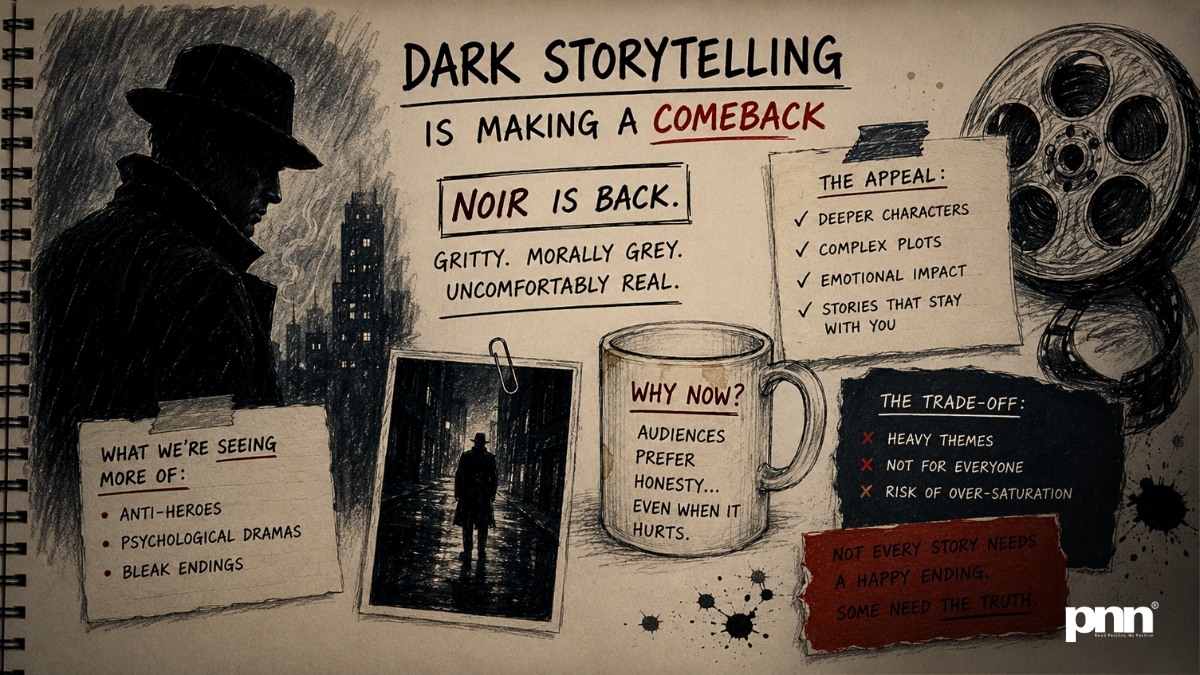
Mumbai (Maharashtra) [India], May 6: There’s a peculiar honesty in darkness. Not the dramatic, overproduced kind, the kind that screams for attention, but the quieter, more unsettling version. The one that lingers. The one that doesn’t resolve itself neatly in two hours with a hopeful soundtrack and a conveniently entertainment redemption arc.
That version is back.
Across films and streaming platforms, “noir”, with its morally ambiguous characters, psychological tension, and endings that feel less like closure and more like resignation, is quietly reclaiming its space. And no, it’s not subtle about it either.
Because apparently, audiences have decided they would rather feel uncomfortable truth than curated optimism.
Charming.
The Return Of Moral Ambiguity
The modern resurgence of noir isn’t just aesthetic. It’s philosophical.
- Anti-heroes are replacing traditional protagonists
- Stories are embracing ethical complexity
- Endings are… less reassuring
Characters no longer need to be likable.
They need to be believable.
And belief, as it turns out, doesn’t always align with virtue.
The Backstory: Noir Never Really Left
To say noir is “returning” is slightly misleading.
It never disappeared; it just evolved.
From classic detective films to contemporary reinterpretations, the genre has always existed in some form. What’s changed is its prominence.
- Earlier: A niche, stylistic choice
- Now: A mainstream narrative direction
The shift isn’t about revival.
It’s about relevance.
The Cultural Context: Why Now?
Timing, as always, is everything.
- Global uncertainty has influenced storytelling preferences
- Audiences are more exposed to complex realities
- Simplistic narratives feel… insufficient
Optimism hasn’t vanished.
It’s just no longer the default.
Because when real life becomes unpredictable, fiction tends to reflect that unpredictability.
The Economics Of Darkness
Let’s introduce numbers, because even existential dread has a budget.
- High-end streaming dramas often range between $50 million to $150 million per season
- Psychological thrillers consistently perform well on global charts
- Dark-themed content tends to generate higher engagement and discussion
Why?
Because complexity keeps audiences invested.
And investment, emotional or otherwise, drives retention.
The Positive Case: Depth, Authenticity, Engagement
There’s a reason this trend is gaining traction.
- Stories feel more grounded
- Characters are multidimensional
- Narratives encourage reflection
From a PR perspective, it’s almost ideal.
Content that:
- Sparks conversation
- Builds loyal audiences
- Differentiates itself in a saturated market
In other words, darkness… sells.
The Slightly Bleak Downsides
Of course, not everything benefits from perpetual gloom.
Emotional Fatigue
- Constant exposure to heavy themes can be exhausting
- Audiences may seek lighter alternatives over time
Creative Homogenization
- Overuse of noir elements can lead to predictability
- “Dark” becomes a formula rather than a philosophy
Limited Accessibility
- Not all viewers resonate with morally complex narratives
- Some prefer clarity over ambiguity
Because while honesty is appreciated, it’s not always comforting.
The Streaming Factor: Algorithms Love Complexity
Streaming platforms have played a significant role in this resurgence.
- Data-driven insights highlight audience preferences
- Engagement metrics favor layered storytelling
- Longer formats allow deeper character exploration
This creates an environment where noir thrives.
Not because it’s trendy.
But because it performs.
The Sarcasm (Because It’s Necessary)
There’s something almost poetic about the situation.
After decades of feel-good narratives, audiences have collectively decided:
“Let’s watch something emotionally devastating tonight.”
Because nothing says relaxation quite like existential ambiguity.
The Creative Shift: From Resolution To Reflection
Traditional storytelling often prioritised closure.
Noir, however, prefers ambiguity.
- Questions over answers
- Consequences of redemption
- Reflection on resolution
This doesn’t make stories incomplete.
It makes them… uncomfortable.
Which, apparently, is the point.
The Audience Evolution: Seeking Something Real
Modern viewers are not passive.
They’re:
- Analytical
- Opinionated
- Emotionally invested
They don’t just consume content.
They interpret it.
And interpretation thrives in complexity.
The Industry Perspective: Strategic Storytelling
For creators and studios, the resurgence of noir is both an opportunity and a challenge.
- Opportunity to explore deeper narratives
- Challenge to maintain originality
Because while darkness attracts attention, it also demands nuance.
Without it, the genre risks becoming… predictable.
The Innovation Trade-Off
As with any trend, balance is key.
Pros:
- Richer storytelling
- Stronger audience engagement
- Greater creative freedom
Cons:
- Risk of over-saturation
- Emotional heaviness
- Reduced appeal for broader audiences
It’s not a flaw.
It’s a calibration.
The Bigger Pattern: Entertainment Reflecting Reality
What we’re seeing isn’t isolated.
Across media:
- Themes are becoming more complex
- Narratives are less idealized
- Characters are more human
Entertainment isn’t escaping reality.
It’s interpreting it.
So, Is Optimism Really Out Of Fashion?
Not entirely.
It’s just… competing.
- Light-hearted content still exists
- Optimistic stories still resonate
But they share space now.
With narratives that are less certain, less polished, and significantly more introspective.
The Final Thought: When Shadows Become Storytelling Tools
The resurgence of noir isn’t a rejection of positivity.
It’s an expansion of perspective.
Stories are no longer required to comfort.
They’re allowed to challenge.
And perhaps that’s the most significant shift.
Because when audiences embrace discomfort, storytelling evolves.
Even if it occasionally leaves us with more questions than answers.
Which, in its own way, feels… honest.